
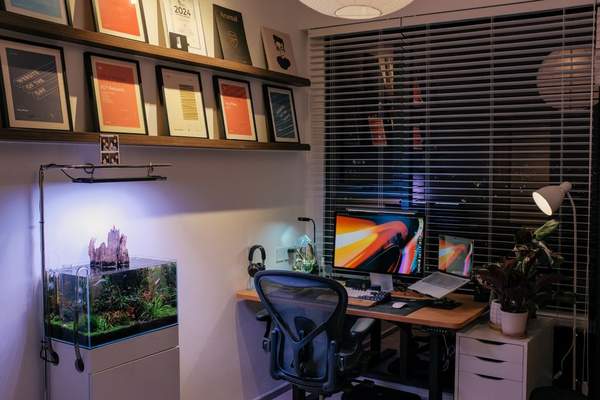
A lush freshwater tank does not have to begin with complicated equipment. A reliable planted aquarium setup starts by matching light, nutrients, substrate, and carbon dioxide to the plants you want to grow. Get that balance right and the aquarium becomes easier to maintain.
Plan Around the Plants, Not the Equipment
Before buying a powerful lamp or pressurized CO2 kit, decide what you want to grow. Java fern, Anubias, Cryptocoryne, and easy stem plants can thrive with modest lighting and no injected carbon dioxide. Dense carpeting plants and demanding red stems usually need more careful control of light, nutrition, and CO2.
A tank around 60–90 litres offers useful planting space and is often easier to keep stable than a very small aquarium. Place it on a level, suitable stand, away from direct sunlight and temperature swings. Choose a reliable filter, a timer-controlled aquarium plant light, a thermometer, and a heater if the intended livestock requires one.
Choose a Substrate That Fits Your Planting Plan
Inert Gravel or Sand
Ordinary aquarium gravel and suitable sand contain little plant nutrition, but they can support a beautiful planted tank setup. Supply nutrients through the water for stem and rhizome plants, and insert root tabs beneath heavy root feeders such as Amazon swords and Cryptocoryne. A planting depth of roughly 5–7 cm gives many rooted species space to anchor.
Nutrient-Rich Aquarium Soil
A planted substrate formulated for aquatic plants can simplify root feeding and help create sloping landscapes. Some active soils change water chemistry and release ammonium during startup, so follow the product instructions and test water carefully. Not every soil is suitable for every fish or shrimp species.
Set the Lighting Before Algae Sets In
Use an LED designed for growing aquarium plants, ideally with adjustable intensity. Brighter is not automatically better: strong light accelerates plant demand for carbon and nutrients, and a new tank may struggle to keep up. Begin with approximately six hours of light daily on a timer, then gradually extend toward seven or eight hours if plants respond well.
Watch the plants rather than chasing a universal wattage figure. Tall, stretched growth may indicate insufficient light, while persistent algae can reflect an imbalance involving light, nutrients, plant mass, and maintenance. Adjust one factor at a time.
Pick Plants for Their Actual Growing Habits
Mix species that occupy different levels of the aquarium. Java fern and Anubias look natural attached to wood or stone; do not bury their thick rhizomes, which can rot. Cryptocoryne suits the middle ground, while Amazon swords need room and root nutrition. Fast-growing water sprite, Hygrophila, or similar easy stems fill the background and consume nutrients as they establish.
Some aquarium plants are grown above water at nurseries. Older leaves may soften or melt after submersion even when healthy roots survive. Look for fresh underwater growth before giving up on a recently planted specimen. For more species choices, see a guide to low-light aquarium plants.
Build the Hardscape and Plant Carefully
Arrange aquarium-safe rocks and driftwood before adding water. Keep swimming space open if fish are planned, and leave room around the filter intake. Prepare hardscape according to its material; avoid stones that alter water chemistry unless they suit the intended livestock.
Remove nursery pots and packing material from roots. Separate stems into small groups and plant them with tweezers rather than burying a large clump. Mist exposed leaves while working. To fill the tank, pour dechlorinated water onto a plate or plastic bag so the stream does not disturb the substrate.
Filtration and Cycling Still Matter
Living plants absorb some nitrogen compounds, but they do not replace biological filtration or water changes. Run the filter continuously, and establish a fishless nitrogen cycle before stocking animals. Beneficial bacteria process ammonia into nitrite and then nitrate. Test ammonia and nitrite; both should read zero before fish are added, with the system demonstrably processing its intended waste load.
Do not buy fish simply because the water looks clear. Cycle duration varies, and adding animals too quickly can expose them to toxic waste. A separate aquarium nitrogen cycle guide is useful here. Once the tank is ready, stock gradually and research each species’ temperature, water, and social requirements.
Feed Plants Without Overcorrecting
Plants need nitrogen, phosphorus, potassium, and trace elements, but more fertilizer is not automatically better. An all-in-one aquarium fertilizer is a sensible starting point for many low-tech tanks. Follow its instructions, begin conservatively in a newly planted aquarium, and adapt dosing to plant growth and water tests. Use root tabs where heavy root feeders need them.
Is Aquarium CO2 Worth Adding?
Injected aquarium CO2 is optional for many beginner plants. A low-tech setup with modest light is simpler and can grow steadily, although demanding carpeting plants may grow slowly or poorly. Pressurized CO2 becomes more useful when high light and fast growth are deliberate goals.
Injection requires a suitable regulator, diffuser, consistent timing, and attention to fish behaviour and gas exchange. Too much dissolved CO2 can harm livestock. Rather than adding carbon dioxide to solve every algae problem, first check lighting duration, plant health, circulation, and maintenance.
A Practical First-Month Routine
Imagine a 75-litre tank planted with Anubias on wood, Cryptocoryne in gravel with root tabs, and Hygrophila in the background. Start the lamp at six hours daily. Keep the filter running, monitor ammonia and nitrite through fishless cycling, and remove decaying leaves promptly. This arrangement gives each plant room to settle before you consider brighter lighting or CO2.
During the first few weeks, change water regularly; nutrient-rich soils may require more frequent changes under their manufacturer’s instructions. Inspect new leaves, wipe algae from glass, and trim vigorous stems. After the tank stabilizes, a weekly partial water change and observation routine are often manageable. Never rinse biological filter media under untreated chlorinated tap water.
Planted Aquarium Setup FAQs
Can aquarium plants grow without CO2 injection?
Yes. Many Java ferns, Anubias, Cryptocoryne, and other undemanding species grow without injected CO2 when light and nutrients are appropriate. Growth may be slower, which also means less trimming.
What substrate is best for beginners?
Both inert gravel with root tabs and dedicated aquarium soil can work. Gravel is flexible and often simpler to manage; soil offers root nutrients but may require closer attention during startup.
How long should planted aquarium lights stay on?
About six hours daily is a useful starting point for a new planted tank. Increase gradually if growth supports it, instead of leaving the light on all day.
When can fish be added to a new planted tank?
Only after the biological filter is cycled and repeated water tests confirm that ammonia and nitrite are zero under the intended waste load. Plants alone do not guarantee safe water.
Let the Aquarium Find Its Rhythm
The healthiest planted aquarium is not necessarily the brightest or most expensive. Choose compatible plants, give their roots and leaves appropriate nutrition, keep lighting consistent, and establish safe water quality before adding fish. Build those habits first; more demanding species and CO2 equipment can come later.