
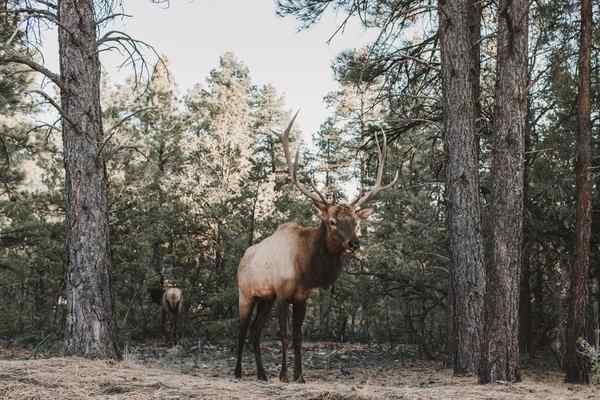
A large brown animal steps out of the trees. Is it a deer or an elk? At a distance, the answer is not always obvious, especially if the animal has no antlers. Size is a strong clue, but the rump, tail, voice, behavior, and location can tell you more.
There is a taxonomic twist to the elk vs deer comparison: elk are deer. Both elk and the animals Americans commonly call deer belong to the family Cervidae. For practical identification in the United States, the useful comparison is elk against white-tailed deer and mule deer.
Elk vs Deer: The Differences at a Glance
Elk generally have taller shoulders, heavier bodies, darker necks, pale rumps, and very short tails. White-tailed deer are smaller and often raise a broad white tail when alarmed. Mule deer have oversized ears, a white rump, and a narrow black-tipped tail. A bull elk may give a piercing autumn bugle, while deer communicate through shorter grunts, snorts, and bleats.
Elk vs Deer Size: How Much Bigger Is an Elk?
The elk vs deer size difference is substantial. According to the National Park Service, mature bull elk in Rocky Mountain National Park commonly weigh about 700–1,000 pounds and stand roughly five feet at the shoulder. Cow elk generally weigh about 300–500 pounds. Weights vary with age, region, and season.
White-tailed bucks often weigh about 150–300 pounds, although populations vary; does are generally lighter. Mule deer may weigh around 100–300 pounds and stand approximately three feet at the shoulder. An adult cow elk can outweigh a large deer buck. Look for the elk’s long-legged, deep-chested outline rather than judging size from antlers alone.
Antlers: Shape Matters More Than Point Count
Mature bull elk antlers rise from long main beams with individual tines sweeping upward and backward. White-tailed bucks typically have tines rising from a main beam; mule deer antlers commonly divide into distinctive forks. Comparing elk antlers with deer antlers works best on mature animals with fully visible racks.
Antlers are bone, not permanent horns. Male elk and most male deer grow a new pair each year under a soft covering called velvet, then shed them after the breeding season. Female elk and most female white-tailed and mule deer have no antlers. Point counts do not reliably reveal exact age, and antlers cannot help much with identifying antlerless animals.
Coat, Rump Patch, Ears, and Tail
Elk commonly have a tan body, darker head and neck, and broad cream-colored rump patch around a short tail. A mature bull’s dark neck can resemble a mane.
White-tailed deer change from reddish-brown summer coats to grayer winter coats. They flash the white underside of their tails when fleeing. Mule deer are often gray-brown, with large ears and a black-tipped tail against a pale rump. Because mule deer and elk both have pale rumps, check the animal’s proportions and tail together. These features are especially useful for deer identification when there are no antlers.
Calls, Herds, and Breeding Behavior
The bull elk’s autumn bugle rises into a high whistle or squeal and often ends in grunts. During the rut, bulls compete for groups of cows through displays and occasional fights. Elk may gather in large herds, particularly in open valleys.
White-tailed and mule deer also form groups, but often smaller ones. Bucks may spend much of the year apart from does. Deer use quieter calls and visual warnings; a white-tailed deer lifting its tail as it bolts is a particularly useful clue. Understanding elk rutting behavior explains why autumn observations can be so dramatic.
Habitat and Geographic Range
Elk habitat often combines meadows rich in grasses with nearby forest cover. Some mountain herds move between higher summer ranges and lower winter valleys. Elk are best known from western North America, although restored populations also live in parts of the eastern United States, including the southern Appalachians.
White-tailed deer occupy much of the United States, thriving in forests, farmland, brushy edges, and suburbs. Mule deer are more characteristic of the West, from sagebrush to mountainous terrain. Their ranges can overlap, so seeing an animal in a Colorado meadow cannot identify it by itself. Knowing the differences between white-tailed deer and mule deer helps in places where all three occur.
Can You Identify Elk and Deer by Tracks?
Both leave paired, cloven hoofprints. Elk tracks tend to be larger and broader than deer tracks, but muddy soil, speed, and the animal’s age can change the impression. One oversized print is not proof of elk. Look at several tracks, stride length, surrounding vegetation, and other signs. A guide to identifying animal tracks can help you compare patterns rather than relying on one print.
A Field Example: Identifying an Antlerless Animal
Imagine spotting a brown, antlerless animal at a meadow edge in Rocky Mountain National Park. First, compare its height with nearby shrubs. Then look for a dark neck, bulky chest, broad pale rump, and very short tail. Together, these point toward a cow elk.
If a much smaller animal bounds away with a narrow black-tipped tail, mule deer is more likely. A broad white tail raised high suggests a white-tailed deer. Several independent clues beat one quick guess, especially when distance distorts size.
Observe Safely
Use binoculars rather than approaching. Elk can be dangerous during the autumn rut, and cows may defend calves in spring. Yellowstone requires visitors to remain at least 25 yards from elk; rules elsewhere can differ. Never block an animal’s path, approach a calf, or use calls to provoke a response. If wildlife reacts to you, move farther away.
Frequently Asked Questions
Are elk a type of deer?
Yes. Elk, white-tailed deer, and mule deer belong to the family Cervidae. In everyday American speech, “deer” usually refers to the smaller white-tailed or mule deer.
Can a female elk be mistaken for a deer?
Yes, especially at a distance. A cow elk is generally much larger than most deer and has a deeper chest, darker neck, and broad pale rump.
Do elk and deer live in the same places?
They can. Elk and mule deer overlap in many western habitats, and white-tailed deer also occur in some of those areas. Habitat is a supporting clue, not a definitive test.
Which animal has bigger antlers?
A mature bull elk generally has much larger antlers than a typical white-tailed or mule deer buck. Age and nutrition affect antler growth, so body shape remains important.
Final Takeaway
The quickest way to tell elk from deer is to combine overall size with the rump, tail, and body outline. Antlers and autumn calls add powerful clues when available; habitat, tracks, and group behavior offer supporting evidence. Look for several signs together, keep your distance, and that large shape emerging from the trees becomes much easier to recognize.