
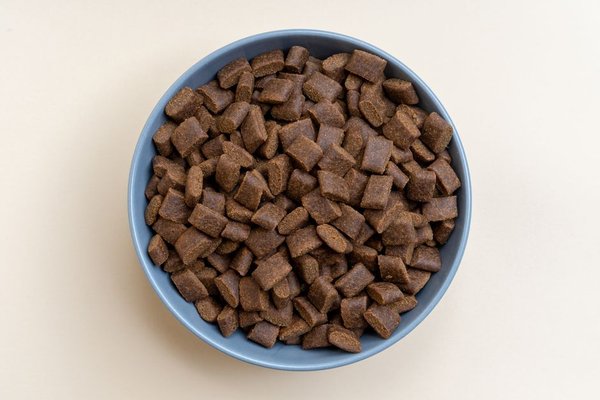
The front of a pet food bag might promise real meat, natural ingredients or advanced nutrition. Yet the most useful information often sits in much smaller print on the back. Learning how to read pet food labels means separating nutritional evidence from advertising and asking a simple question: does this product suit the animal eating it?
Labels are especially easy to misread when comparing wet and dry foods, or shopping for different species. Here is how to use the label to make a more informed choice.
Check the species and life stage first
Before studying the ingredient list, confirm which animal the food is designed for. Cats and dogs have different nutritional requirements; for example, cats need adequate dietary taurine and preformed vitamin A. A dog food is not automatically suitable as a cat’s main diet, even if the ingredients appear similar.
Age and condition matter too. Growing puppies and kittens need different nutrient balances from healthy adults. For rabbits, guinea pigs and other small mammals, assess the product against that species’ needs rather than applying dog-and-cat labeling rules indiscriminately.
Find the nutritional adequacy statement
On many US dog and cat foods, the nutritional adequacy statement is more informative than the largest claim on the package. Look for wording indicating the food is complete and balanced for a specified life stage. That means the product is intended to supply the required nutrients when fed appropriately, not merely to provide a tasty addition.
A statement may say the formula meets AAFCO nutrient profiles or that nutritional adequacy was substantiated through animal feeding tests using AAFCO procedures. These are different ways of supporting the claim; neither guarantees that every individual pet will thrive on the food.
Read the life-stage wording carefully. Adult maintenance is not equivalent to growth. An all-life-stages claim covers broader nutritional requirements, but it does not mean the calorie density or portions are ideal for every adult animal. For large-breed puppies, check whether the growth statement includes or excludes dogs expected to weigh 70 pounds or more as adults.
If the packaging says “for intermittent or supplemental feeding only,” it should not ordinarily replace a complete daily diet. Treats, toppers and some therapeutic products have different purposes. The useful next step is understanding your pet’s life-stage nutrition before choosing the main food.
Read pet food ingredients without jumping to conclusions
In the United States, pet food ingredients are generally listed in descending order by weight as added to the formula. This tells you which ingredients weighed most before processing, but not their precise proportions or the nutritional contribution of each one.
Fresh chicken, for instance, contains substantial water. After cooking, its contribution to the finished dry food may look different from its prominent position on the original list. Conversely, a named meat meal is concentrated because much of the moisture has already been removed.
Be cautious about judging a formula solely by the first five ingredients. Vitamins, minerals and other nutrients appear in small amounts because pets need them in small amounts. Grain-free also does not automatically mean healthier, and unfamiliar ingredient names are not proof that something is harmful.
Understand the guaranteed analysis
The guaranteed analysis on a typical US pet food label reports minimum crude protein and crude fat, plus maximum crude fiber and moisture. “Crude” refers to the laboratory measurement method, not low-grade nutrition. These figures describe labeled limits rather than exact amounts in every serving.
Moisture creates a common comparison trap. A wet food showing 8% protein may contain a higher proportion of protein in its dry matter than a kibble showing 24%. To compare fairly, first remove the water mathematically.
A simple wet-versus-dry example
Suppose a canned food lists 8% protein and 78% moisture. Its dry matter is 22%, so 8 divided by 22, multiplied by 100, gives approximately 36% protein on a dry-matter basis. A dry food listing 24% protein and 10% moisture works out to approximately 27% using the same calculation.
Those are illustrations based on guarantee figures, not precise laboratory comparisons. Because protein is listed as a minimum and moisture as a maximum, ask the manufacturer for typical nutrient values if a close comparison matters. Protein percentages alone also cannot tell you digestibility, amino-acid balance or suitability for a specific pet.
Use calorie statements and feeding directions together
Look for “Calorie Content,” commonly expressed as kilocalories per kilogram and per cup, can or other familiar unit on US dog and cat foods. The number matters because similarly sized scoops of different products may deliver very different amounts of energy.
Imagine a food supplies 360 calories per cup and your veterinarian estimates a daily food allowance of 540 calories. That works out to 1.5 cups across the day before accounting for treats or other foods. A second brand at 450 calories per cup would require only 1.2 cups for the same 540 calories.
Feeding charts are starting points, not personalized prescriptions. Activity, age, neuter status and body condition can change an animal’s needs. Measure portions consistently, monitor weight and body condition, and adjust with professional advice when appropriate. A guide to pet portion sizes can make this calculation easier to revisit.
Question claims on the front of the package
Words such as premium, holistic and veterinarian recommended can sound reassuring without telling you whether the diet is nutritionally appropriate. “Natural” has a specific meaning under AAFCO’s model framework, but it is not a guarantee of better nutrition or safety. Organic relates to production standards, not automatic nutritional superiority.
Product names also deserve scrutiny. Under US model rules, a food labeled “with beef” can contain far less beef than a product simply named “beef dog food.” Read the full ingredient statement and adequacy information instead of relying on the front-panel wording.
Finally, check the manufacturer or distributor details and keep the package lot information in case a product question or recall arises. If you are comparing diets for a cat, a focused guide to cat nutrition basics offers more useful context than marketing claims alone.
Frequently asked questions
Does the first ingredient show the best pet food?
No. Ingredients are ordered by their weight before processing. Water content and the rest of the formula make the first ingredient an unreliable shortcut for nutritional quality.
Is higher crude protein always better?
No. Animals require appropriate amounts and sources of nutrients, not the highest number on a package. Life stage, overall formulation and individual health needs matter more.
Can I compare wet and dry food protein directly?
Not fairly using the printed percentages alone. Calculate on a dry-matter basis, and seek typical nutrient analyses when accuracy is important.
Does complete and balanced mean a food is right for every pet?
No. The claim applies to an identified species and life stage. Portion size, health conditions and how the animal responds still matter.
Make the label work for your pet
The most practical approach is to read each pet food label in this order: species, nutritional adequacy, calories, feeding directions, guaranteed analysis, then ingredients and claims. That sequence puts nutritional suitability ahead of packaging language and turns a crowded label into a useful decision tool.